From Aristocratic Roots to Cultural Revolution
Given the importance of its Olympic history, ice dance was deeply embedded in European aristocratic ballroom traditions. Think elegant waltzes, upright posture, romantic storylines, and clearly defined gender roles. Ruffles, tails, and restrained emotion once defined the discipline.
That image is changing — dramatically.
At this year’s Olympic Games, ice dance is stepping into a very different ballroom. One shaped by voguing, waacking, duck walks, corsets, and unapologetic self-expression. Drawing inspiration from Black queer ballroom culture and popularized through shows like RuPaul’s Drag Race, the rhythm dance is incorporating queer aesthetics in a way never before seen on the Olympic stage.
A Traditionally Conservative Sport Begins to Shift
Despite common assumptions, ice dance has long been one of the most heteronormative disciplines in figure skating. Judges historically rewarded performances centered on heterosexual love stories, often portraying a man and woman falling in love on the ice.
Adding to that conservatism, the sport’s former powerhouse, Russia, has banned LGBTQ+ advocacy altogether. Until 2022, ice dance had never crowned an openly gay Olympic champion.
Yet beneath the sequins and dramatic arm movements, ice dance remains a highly technical sport. It demands razor-sharp edges, deep knee bends, precise balance, and lightning-fast turns. For new spectators, the key is to watch from the skates up — focus on how athletes lean, shift weight, and carve the ice. While artistic expression takes center stage, the scoring is far less subjective than it may appear.
Why the 1990s — and Why Now?
In an effort to attract younger audiences, skating officials asked teams to choose music from the 1990s for this season’s rhythm dance.
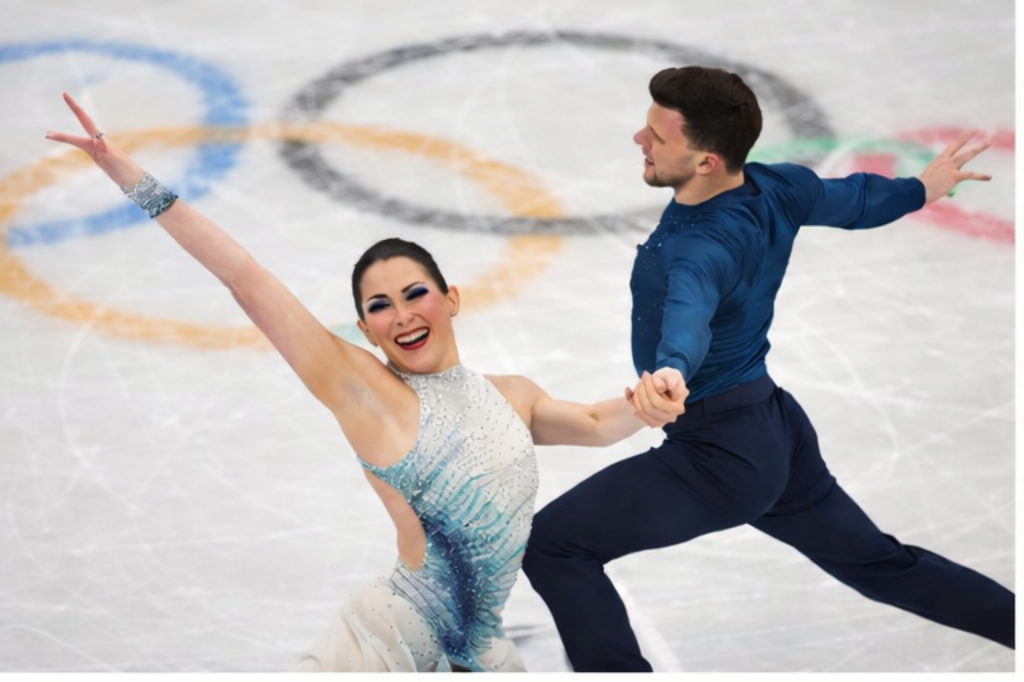
For Canadian veterans Piper Gilles and Paul Poirier, the decision was immediate. They chose RuPaul’s iconic track “Supermodel.”
“We wanted to embrace the idea of the ’90s supermodel — that energy of confidence and inner fabulousness,” Poirier explained. Because the song is performed by a drag icon, the pair leaned fully into drag and ballroom influences, blending them seamlessly with the five required technical elements in a demanding 2-minute-and-40-second routine.
Gilles appears in a shimmering silver bustier, channeling runway glamour. Poirier skates beside her in a black corset, portraying a cool, dismissive queer dandy.
“That is the highest compliment,” Poirier said when asked about the characterization.
Representation on Ice: A Personal and Cultural Milestone
“For me, as a queer person, it’s incredibly meaningful to see all of that reflected in our routine,” Poirier added. “I still appreciate the traditional ballroom roots of ice dance, but the sport has evolved — especially over the past decade.”
Gilles and Poirier are competing in their third Olympic Games and find themselves in a fiercely competitive five-team race for the podium. Notably, this marks the first Olympics since 1984 in which no ice dance team has previously won an Olympic medal.
Their strengths lie in musicality, precision, and character-driven performance. While they may not be the fastest team, their originality and attention to detail consistently set them apart.
France Brings Power, Precision, and Vogue
They are not alone in drawing from queer ballroom culture.
France’s Laurence Fournier Beaudry and Guillaume Cizeron — the 2022 Olympic gold medalist — are also embracing drag and ballroom influences. Skating to Madonna’s “Vogue,” the pair incorporate waacking and bold, runway-inspired movement. Their costumes echo underground ballroom aesthetics, reinforcing the theme.
Though newly paired, Fournier Beaudry and Cizeron form a formidable team. His elegance combined with her strength allows them to glide across the rink in long, controlled strides. Many consider them favorites for gold.
Still, their elongated, stylized movement can be a disadvantage in the rhythm dance, where judges prioritize strict adherence to required patterns over interpretive freedom.
Traditional Excellence Meets Modern Energy
Standing in contrast are Americans Madison Chock and Evan Bates, three-time world champions and one of the most consistent teams in the sport. Married off the ice, their partnership reflects classic ice dance ideals.
Their rhythm dance features a medley of Lenny Kravitz songs, perfectly suited to Chock’s magnetic presence and Bates’s deep, steady edges.
Britain’s Lilah Fear and Lewis Gibson bring explosive energy to the competition, skating to a Spice Girls medley. While they may lack the refined technique of top contenders, their excitement and contemporary style resonate with judges eager to see the sport evolve.
Italy’s Charlene Guignard and Marco Fabbri enter as hometown favorites. Though their world championship placements have slipped in recent years, they remain technically strong and emotionally compelling — especially skating in front of a home crowd.
Understanding the Rhythm Dance Rules
In the rhythm dance, every team must execute the same step pattern at 120 beats per minute. The sequence begins directly in front of the judges, travels across the ice in broad curves, and finishes exactly where it started.
Teams must also perform:
-
A controlled lift that does not rise above the partner’s head
-
Synchronized traveling spins, known as twizzles
-
A one-foot step sequence
-
A choreographed groove section, typically performed in front of the judges
It’s during this final groove that audiences will see voguing, waacking, and ballroom-inspired movement take center stage.
A New Era for Olympic Ice Dance
Other teams to watch include U.S. silver medalists Emilea Zingas and Vadym Kolesnik, France’s Evgeniia Lopareva and Geoffrey Brissaud, and Canada’s Marjorie Lajoie and Zachary Lagha.
This Olympic season represents more than a medal chase. It marks a cultural shift. Ice dance — once defined by rigid tradition — is opening its doors to queer expression, underground ballroom influence, and broader creativity.
For the first time, the Olympic ice feels like a runway — and everyone is invited to walk it.

 Sports