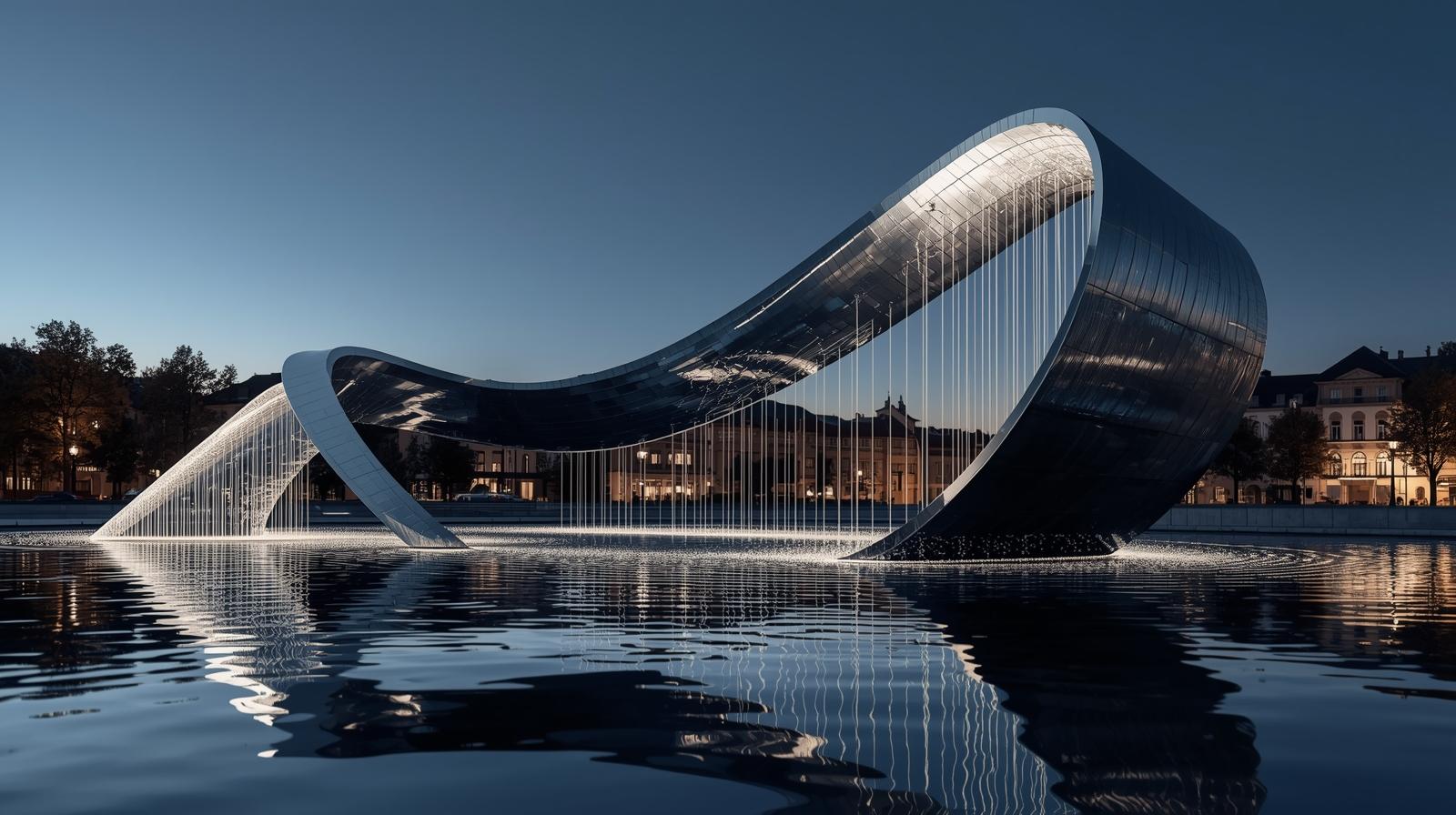
In the bustling heart of Ljubljana, Slovenia, a new public art installation is transforming the way residents and visitors engage with the city’s urban fabric. Known as Water Sculpture LJ, the project stands as a testament to the power of contemporary design to shape public space and enhance experiential connections with the built environment. Conceived by the collaborative architectural studios P PLUS arhitekti and M.KOCBEK architects, this sculptural intervention marries form, function, and symbolism in a way that resonates deeply with Ljubljana’s cultural context and urban dynamics.
A Continuous Loop as a New Urban Landmark
Completed in 2025, Water Sculpture LJ emerged nine years after the design won a public competition aimed at integrating compelling architectural form into the city’s dense core. Rather than presenting a conventional monument to be merely observed from a distance, the piece was designed as an interactive spatial experience that invites movement, engagement, contemplation, and rest.
At its essence, the sculpture takes the shape of a continuous spatial loop — a vast, curved band of polished stainless steel that appears to flow through the landscape like liquid metal. Its sweeping geometry, devoid of beginning or end, never frames the surrounding city in the same way twice. As pedestrians approach, pass through, and circumnavigate the loop, their perspective shifts in subtle and dramatic ways, making every view unique.
Design Philosophy: Movement, Flow, and Connectivity
The design is rooted in themes of movement, fluidity, and flow — ideas that are reinforced both visually and conceptually. The stainless steel surface, highly reflective and responsive to light, weather, and time of day, ensures the sculpture never appears static. By reflecting its surroundings — from the changing skies to passing commuters — the installation seemingly blurs the boundary between object and environment.
This dynamic quality echoes the natural and urban cycles that define life in a capital city. Water, a central motif in the sculpture, circulates as part of a continuous loop mechanism, enhancing the piece’s symbolic emphasis on cycles and renewal. The presence of water is both literal and metaphoric, a reminder of nature’s constancy and the essential role water plays in human societies.
Materiality and Interaction: Stainless Steel and Urban Life
The architects intentionally chose stainless steel for its durability and reflective properties. In an urban setting where materials are constantly exposed to wear and environmental influence, stainless steel offers longevity while capturing the visual energy of the city. Throughout the day, as sunlight shifts and weather varies, the sculpture’s appearance changes — sometimes glowing warmly under golden hour light, at other times almost disappearing into the backdrop on overcast days.
Rather than functioning as an isolated art object, Water Sculpture LJ dissolves the typical spectator‑artwork relationship. Its design encourages direct physical engagement, with spaces integrated into the form that allow people to sit, touch, and pass through the loop itself. Where many sculptures act as visual endpoints, this installation acts as a pathway and micro‑environment, fostering human interaction and social activation within the public realm.
Human Experience and Urban Integration
Placed along Slovenska cesta, one of Ljubljana’s main thoroughfares, the sculpture navigates a complex urban intersection where movement and pedestrian activity are in constant dialogue. The loop does not block or divide the surrounding environment; instead, it gently connects different areas and invites flow on multiple axes. In doing so, it reinforces Ljubljana’s commitment to human‑scaled, accessible public spaces that prioritize interaction over separation.
By creating a new urban “platform”, the design adds spatial complexity to an area otherwise dominated by traffic and circulation. Its presence prompts pause, reflection, and social engagement — transforming an ordinary public corridor into a place of communal experience. The sculpture has quickly become a visual anchor within the city’s network of public spaces, drawing both locals and visitors to explore its curves and reflective surfaces.
Symbolism: Water, Continuity, and Nature’s Cycles
While the design excels as a spatial intervention, its conceptual depth is equally compelling. The continuous loop and the circulation of water embody a philosophical interpretation of natural cycles — of life, movement, and transformation. Water, present in its unbroken flow, serves as a visual metaphor for renewal and connectedness, encouraging observers to consider the relationship between humans and the environment.
In a broader sense, the sculpture speaks to the interconnectedness of human activity and natural processes. As light, weather, and human interaction transform the installation’s appearance, it becomes a living part of the urban environment, bridging the visible with the intangible and the individual with the collective.
Public Space and Contemporary Art in Ljubljana
The realization of Water Sculpture LJ highlights a growing trend in contemporary public art: the drive to move beyond traditional monuments toward experiential, participatory installations. By integrating architectural rigor with artistic intent, the project demonstrates how urban art can serve both aesthetic and functional roles. It enriches the visual landscape while creating meaningful opportunities for public engagement.
For Ljubljana — a city known for its rich cultural history and innovative urban design — Water Sculpture LJ marks a significant contribution to its evolving identity. It reinforces the idea that public artworks can enhance the social fabric of cities, creating environments that are both beautiful and actively woven into the rhythms of everyday life.

 Art
Art